

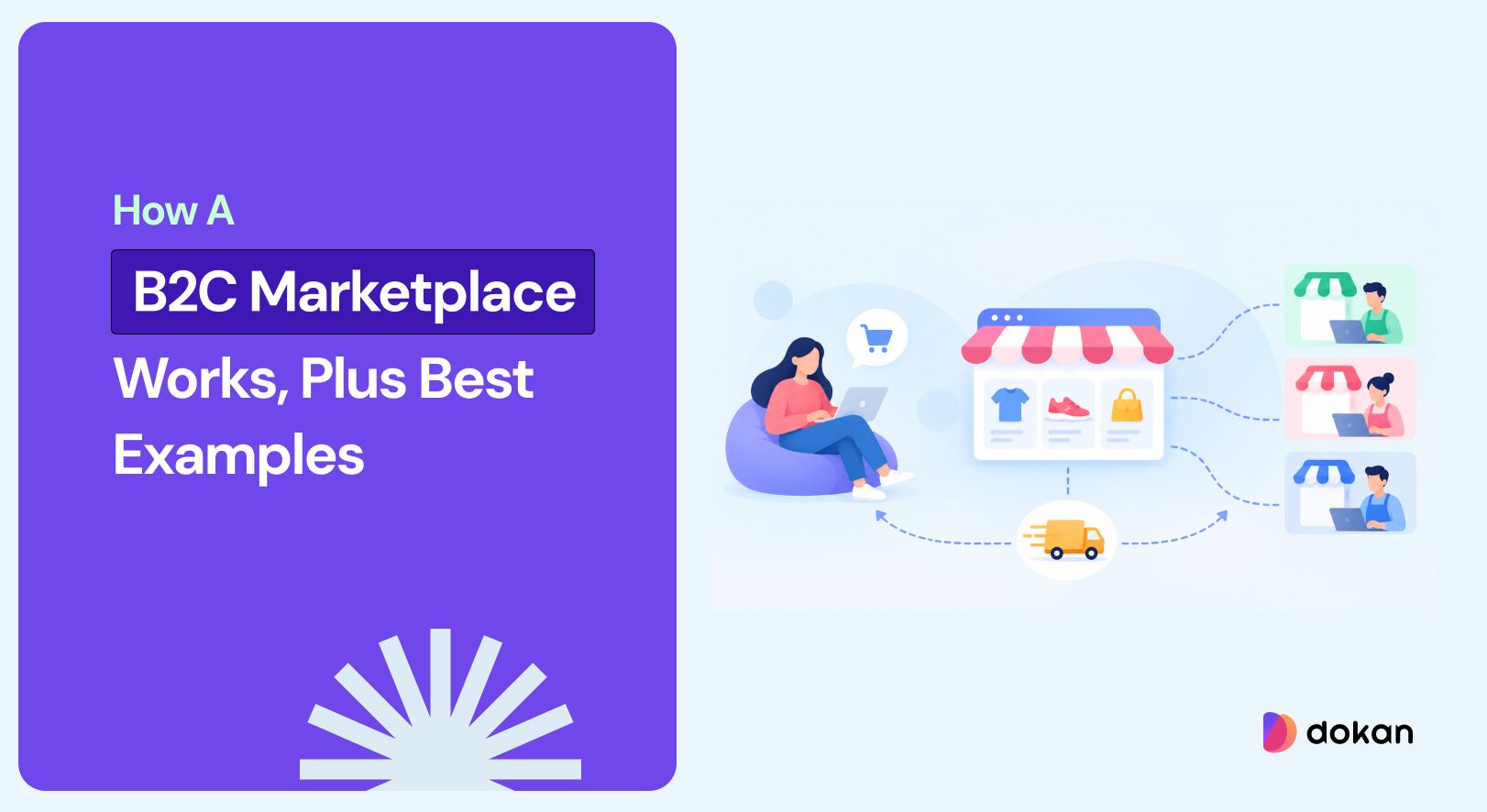
Amazon does not make most of what it sells. Etsy has never produced a candle. Walmart’s online catalogue runs into the hundreds of millions of items, and Walmart owns a fraction of them.
All three are B2C marketplaces. They connect independent sellers to individual shoppers, take a cut of each sale, and never touch the inventory. It is the most common marketplace model on the internet and the one most people picture when they think about buying online.
This guide covers what a B2C marketplace is, how the money actually moves, how it differs from the other marketplace types, real examples worth studying, and what it takes to build one.
TLDR
- A B2C marketplace is a platform where multiple businesses sell directly to individual consumers, and the platform owner sells nothing.
- The operator makes money from commission, listing fees, seller subscriptions, advertising, or fulfilment services. Most large ones use several at once.
- It differs from B2B by buyer type, from C2C by seller type, and from a single-vendor store by who owns the inventory.
- The hard part is never the software. It is recruiting enough sellers to make the first buyers worth serving.
- Amazon, Etsy, Walmart Marketplace, Zalando and Rakuten are the models worth studying, and each solved the cold start differently.
- Building one no longer needs custom development. A WordPress site plus Dokan gives you vendor registration, storefronts, commission and payouts.
What Is a B2C Marketplace?
A B2C marketplace is an online platform where multiple independent businesses sell products or services directly to individual consumers, while the platform operator provides the infrastructure and takes a fee on each transaction.
The defining feature is what the operator does not do. They do not buy stock, set prices, or ship orders. They run the place where those things happen, and they are paid for running it.
That single distinction separates a business to consumer marketplace from an ordinary online shop. A shop owns what it sells and profits on the margin. A marketplace owns the transaction and profits on the fee.
How Does a B2C Marketplace Actually Work?
Six things happen, in this order, on every marketplace of this type.
| Stage | What happens | Who does it |
|---|---|---|
| 1. Seller onboarding | A business registers, gets verified, and opens a storefront | Seller, approved by the operator |
| 2. Listing | Products are uploaded with prices, stock and images | Seller |
| 3. Browsing | A shopper searches, browses or arrives from Google | The platform |
| 4. Checkout | One cart, one payment, even across several sellers | The platform |
| 5. Fulfilment | The order reaches the seller, who ships it | Seller, or the platform if it offers fulfilment |
| 6. Settlement | Commission is deducted and the rest is paid out | The platform |
Stage four is where marketplaces earn their existence. A shopper buying from three sellers pays once, to you, and never sees the split. Getting that right, then paying each seller correctly afterwards, is the actual product.
How Do B2C Marketplaces Make Money?
Five revenue models exist, and mature platforms run several together.
- Commission per sale. A percentage of each order. The default, and the only model where your income rises automatically with seller success.
- Seller subscriptions. A monthly or annual fee for the right to sell, often tiered by listing volume. Predictable revenue that does not depend on sales.
- Listing fees. A small charge per item listed, which discourages catalogue spam as much as it earns.
- Advertising. Sellers pay for placement in search results or category pages. On large platforms this is frequently more profitable than commission.
- Value-added services. Fulfilment, storage, photography, insurance, or promoted analytics.
Most operators start with commission alone, because it is the only model a seller will accept before the marketplace has proven it can deliver buyers. Subscriptions and advertising come later, once selling on your platform is worth paying for in advance.
B2C vs B2B vs C2C, What Is the Difference?
The four marketplace types are separated by who sells and who buys, not by what is sold.
| Type | Seller | Buyer | Example |
|---|---|---|---|
| B2C | Business | Individual consumer | Amazon, Etsy |
| B2B | Business | Another business | Alibaba |
| C2C | Individual | Individual | eBay, Vinted |
| P2P | Individual | Individual, often for access rather than ownership | Airbnb |
Access-based platforms such as Airbnb run on different economics again, which our guide to peer-to-peer marketplaces works through.
Those lines blur in practice. eBay began as C2C and is now substantially B2C. Amazon runs first-party retail alongside its marketplace. What matters for your build is which side you are recruiting, because a business seller expects bulk tools and an individual seller expects a listing form.
What Are the Best B2C Marketplace Examples?
Five worth studying, each for a different reason.
Amazon
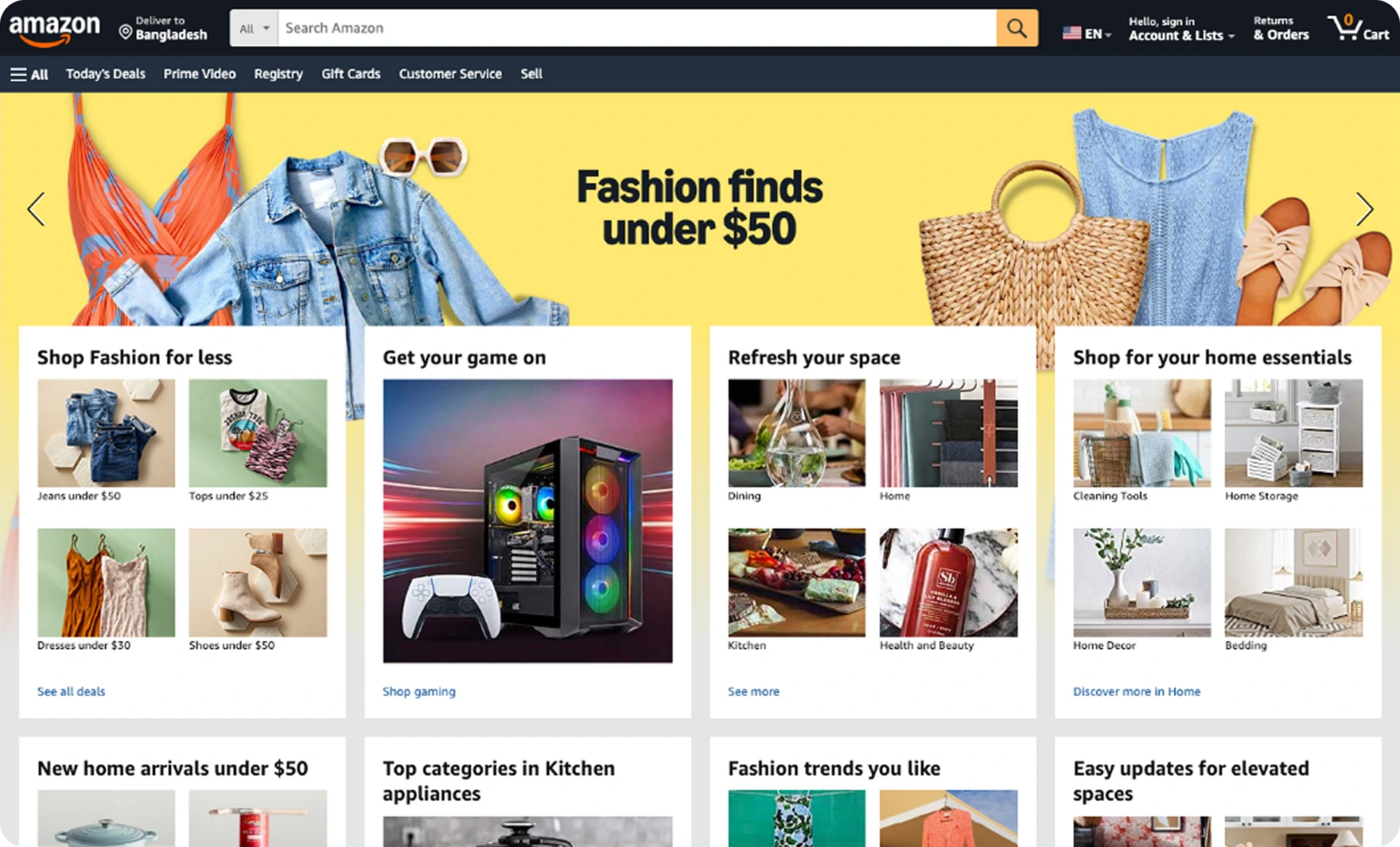
The reference implementation, and a useful warning. Third-party sellers account for the majority of units sold, which means the world’s largest retailer is mostly a marketplace wearing a retailer’s coat. What it teaches is that fulfilment infrastructure, not software, became the moat.
Etsy
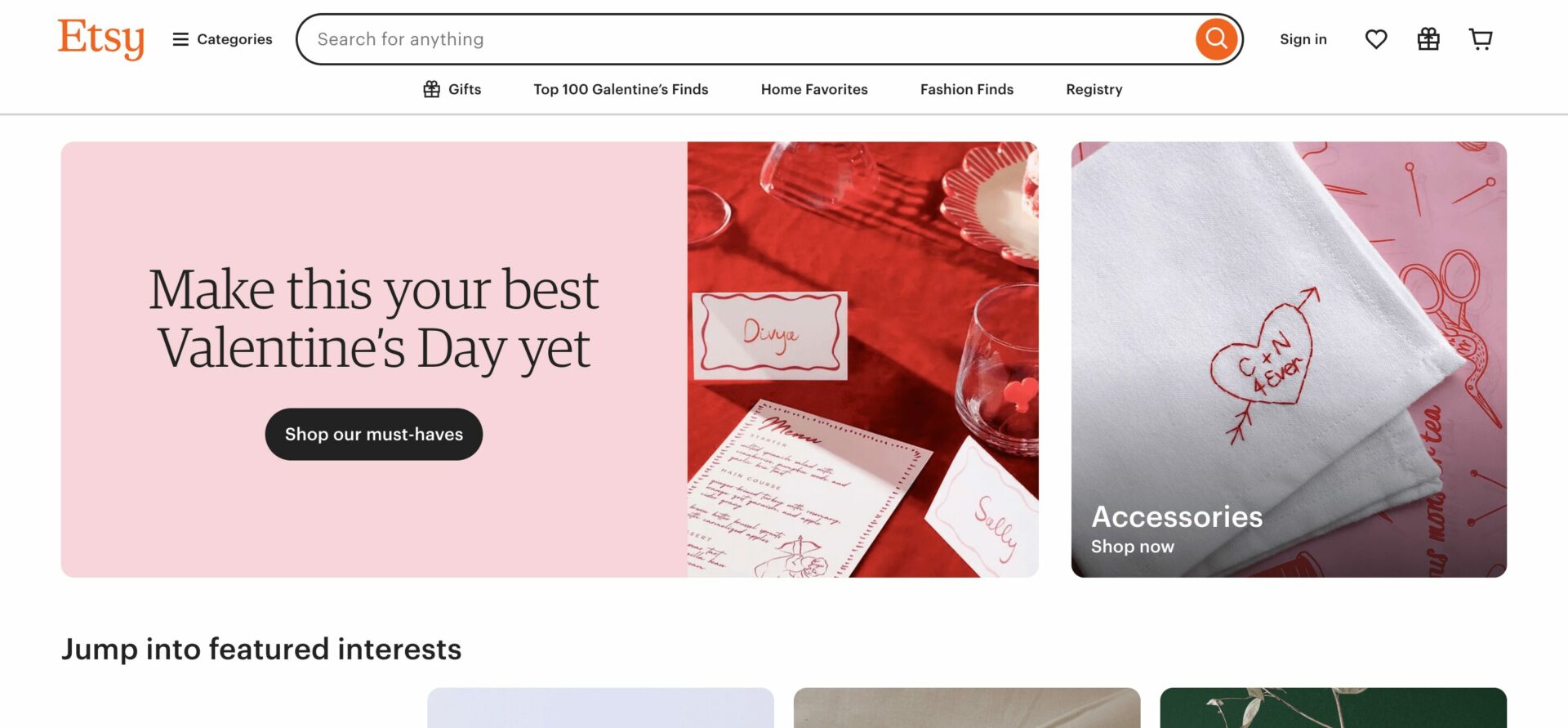
Proof that narrow beats broad at the start. Etsy did not try to sell everything. It sold handmade and vintage goods to people who specifically wanted handmade and vintage goods, and that constraint is what let it recruit sellers Amazon could not.
Walmart Marketplace
The retailer-turned-marketplace route. Walmart already had buyers, so it opened its catalogue to third-party sellers and skipped the cold start entirely. If you have an existing customer base, this is the model to copy.
Zalando
A category specialist that went the other way, starting as a retailer and adding a marketplace once it owned fashion buyers in Europe. It shows that first-party and third-party inventory can coexist under one brand.
Rakuten
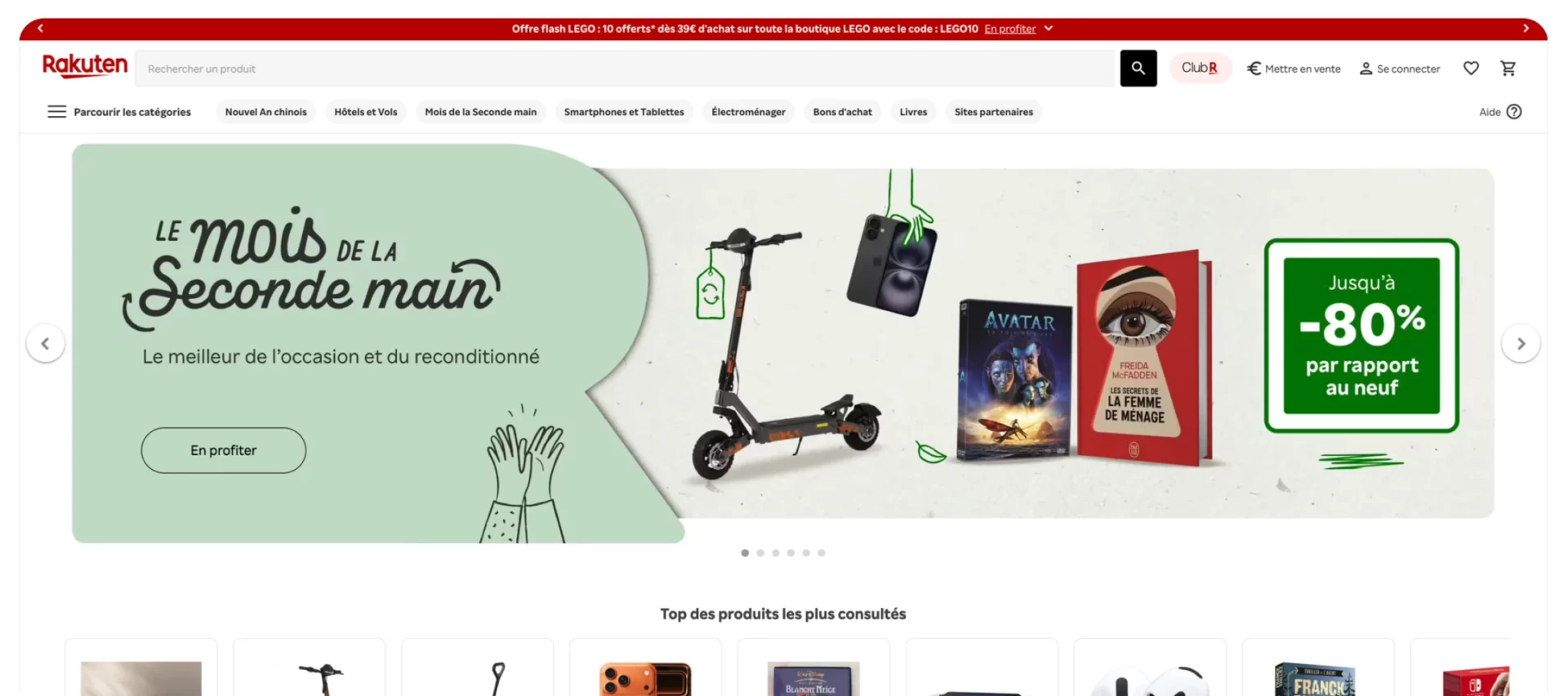
The loyalty-led model. Rakuten built its position on points and cashback rather than on price or selection, which is a reminder that the reason shoppers return does not have to be the catalogue.
For a broader survey, our roundup of the biggest ecommerce marketplaces covers twenty more with their categories and reach.
What Makes a B2C Marketplace Succeed or Fail?
The software is rarely the problem. Four things decide it.
Solving the cold start. Buyers will not come without sellers and sellers will not come without buyers. Every marketplace that worked built one side by hand, unscalably, until the other had a reason to appear. Usually that means recruiting supply first.
Choosing a narrow enough category. A marketplace for everything competes with Amazon on day one. A marketplace for one category, one city, or one kind of buyer competes with nobody.
Making the commission defensible. Sellers will pay a cut for buyers they could not reach alone. They will not pay for a listing page they could have built themselves.
Keeping quality consistent. Every bad seller damages your brand, not theirs, because the shopper bought from you. Verification and reviews are not optional extras, they are the product.
Our guide to the marketplace mistakes to avoid covers the operational versions of these.
What B2C Marketplace Software Do You Need?
Whatever you choose has to handle six things, and most general ecommerce platforms handle none of them out of the box.
- Vendor registration, approval and verification
- An individual storefront and dashboard for each seller
- Commission calculation, by seller, product or category
- Split payments and automated payouts
- Per-vendor shipping rules and order routing
- Reporting that separates marketplace revenue from seller revenue
Three routes exist for a B2C marketplace solution. Custom development, which is the most flexible and by far the most expensive. A hosted marketplace SaaS, which is fastest but ties your platform cost to your revenue. Or a self-hosted plugin on a CMS you already control.
Building a B2C Marketplace With Dokan
Dokan takes the third route. It extends WooCommerce into a full multivendor marketplace, so vendors register themselves, get their own branded storefront and dashboard, list their own products, and your commission is calculated automatically on every order.
For a B2C marketplace specifically, the relevant parts are these.
- Self-service vendor onboarding with social login, phone and photo ID verification, so you are not approving sellers by email.
- Commission by vendor, product or category, which matters once your categories have different margins.
- Every product type, covering physical goods, digital downloads, bookings, auctions and subscriptions.
- Per-vendor shipping with zones and rules, since a marketplace rarely ships from one warehouse.
- Split payouts, including PayPal with automated commission splits.
- Dokan Lite is free with unlimited vendors, so you can run a real marketplace at no licence cost while you recruit your first sellers.
That last point matters more than it looks. The expensive part of starting a marketplace used to be building it, which is why so much advice tells you to validate for months first. When the software costs nothing, testing with real sellers and real orders becomes the cheaper option.
Frequently Asked Questions
1. What is the difference between a B2C marketplace and an online store?
Ownership of the inventory. An online store buys products and resells them at a margin. A B2C marketplace never owns the stock and earns a fee on transactions between its sellers and its buyers. The store carries the risk, the marketplace carries the traffic.
2. How much commission do B2C marketplaces charge?
Commonly between 5 and 20 percent, varying by category and by how much the platform provides. Categories with thin margins, like electronics, sit at the low end. Handmade, fashion and services sit higher. B2B rates run lower on larger order values, as our guide on building a B2B marketplace explains.
3. Do I need sellers before I launch?
Yes. A marketplace with no listings gives a first-time visitor nothing to do, and they rarely return. Recruit ten sellers by hand and get their catalogues live before you drive any traffic.
4. Can a B2C marketplace sell services rather than products?
Yes, and many do. Bookings, appointments, classes and rentals all work on the same commission mechanics. What changes is the fulfilment stage, since you are coordinating a calendar rather than a shipment.
5. Is B2C marketplace development expensive?
It depends entirely on the route. Custom builds run into five and six figures. A hosted platform costs a monthly subscription plus a share of sales. A self-hosted plugin can cost nothing to start. Our breakdown of what it costs to build a marketplace website prices all three.
6. How long does it take to launch one?
The software can be live in a day. Recruiting the first ten sellers and getting their catalogues loaded usually takes four to eight weeks, and that is the real launch date.
Start Narrow, Recruit Supply, Then Open the Doors
A B2C marketplace is a simple idea with a hard first year. Multiple businesses sell to individual consumers, you provide the place and the payment, and you take a cut. Every platform in the examples above works exactly that way.
What separates the ones that survive is not the software. It is picking a category narrow enough to win, recruiting sellers before buyers, and making the commission feel fair to the people paying it.
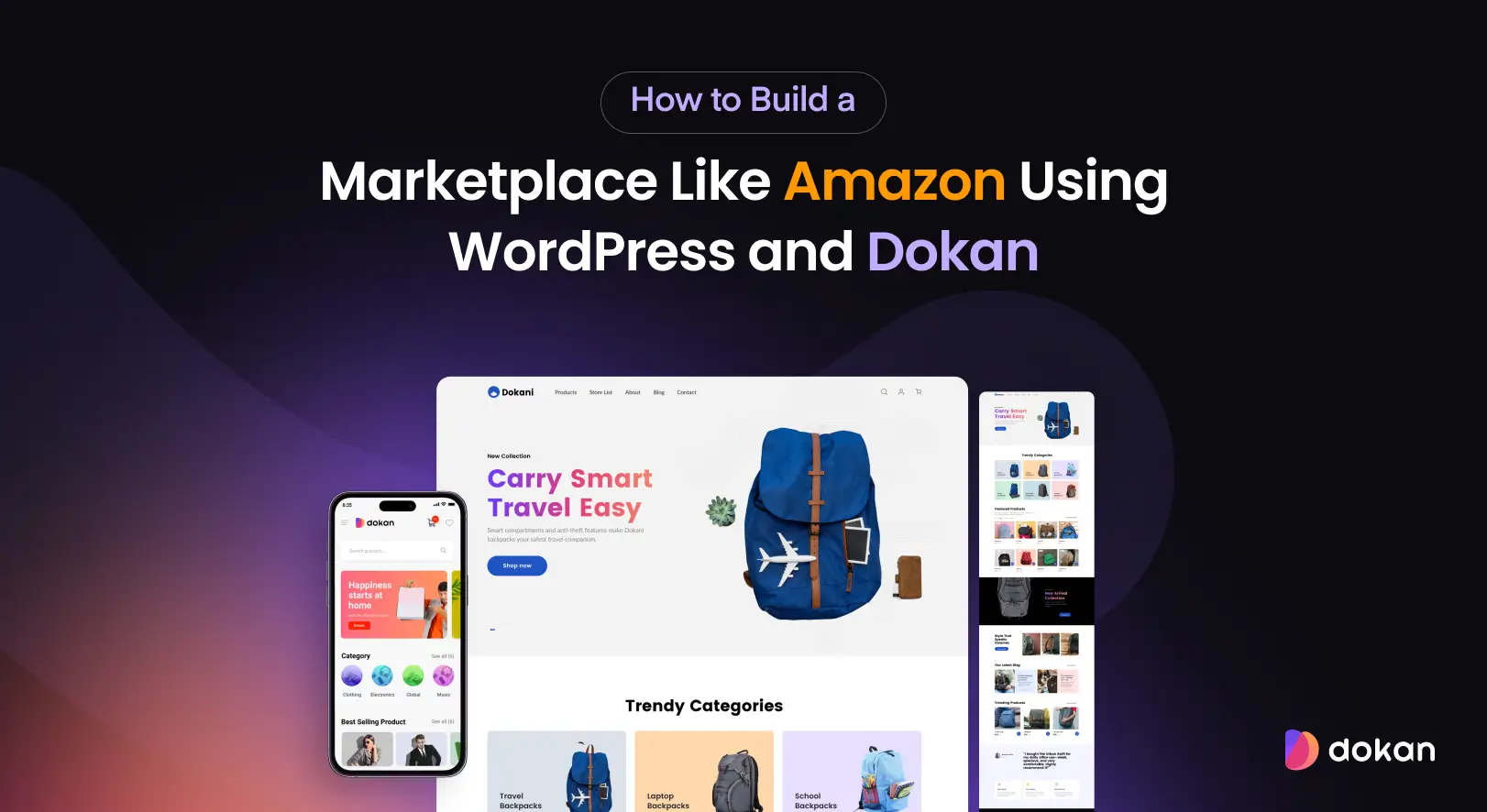
The build itself is the part that got easier. If you want to see how the pieces fit together before committing to anything, our step-by-step guide on building a marketplace like Amazon walks through a full setup from installation to first order.
Subscribe to
Dokan blog
We send weekly newsletters, no spam for sure!



Leave a Reply